 Partners Login
 Contact Us
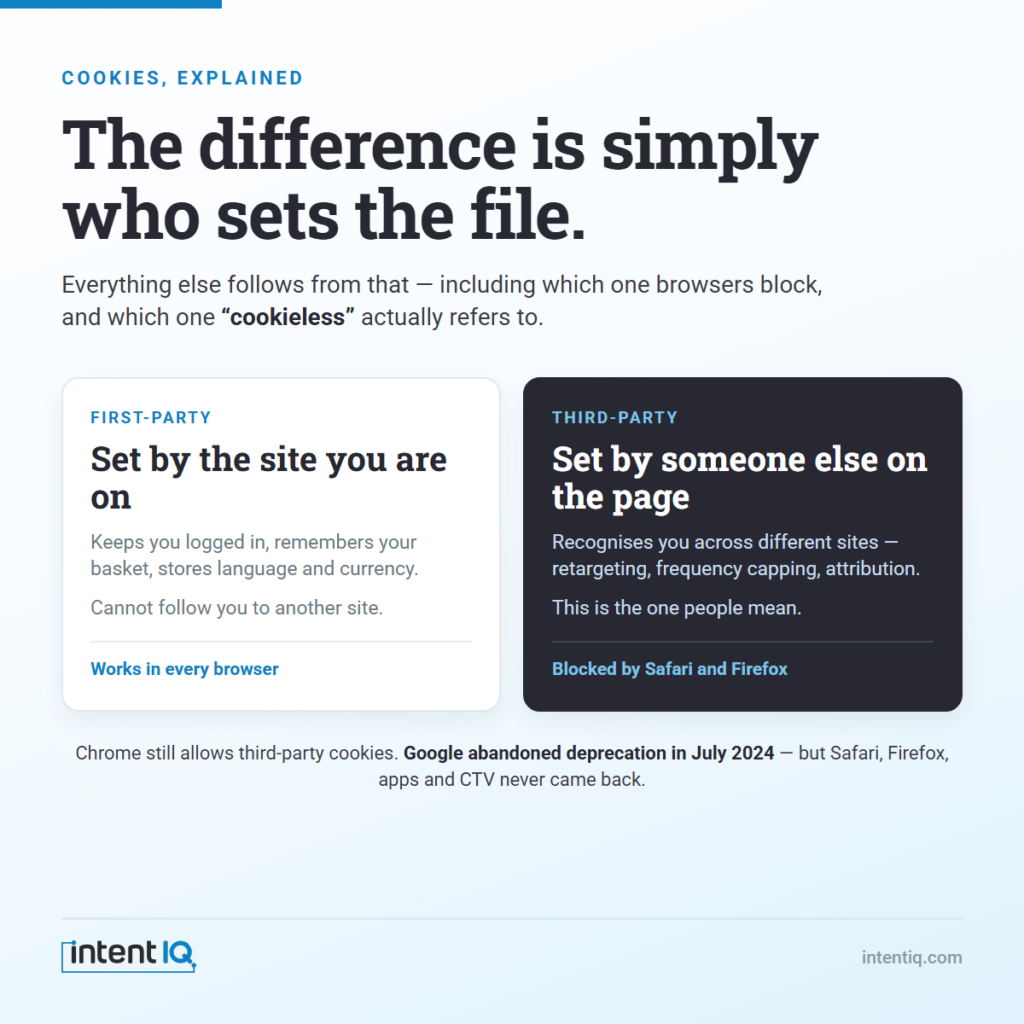
First-Party vs Third-Party Cookies: What’s the Difference?
First-party cookies are set by the site you are on; third-party cookies by someone else. What each does, what changed in Chrome, and what it means for advertising.
Read More

First-party cookies are set by the site you are on; third-party cookies by someone else. What each does, what changed in Chrome, and what it means for advertising.
Read More
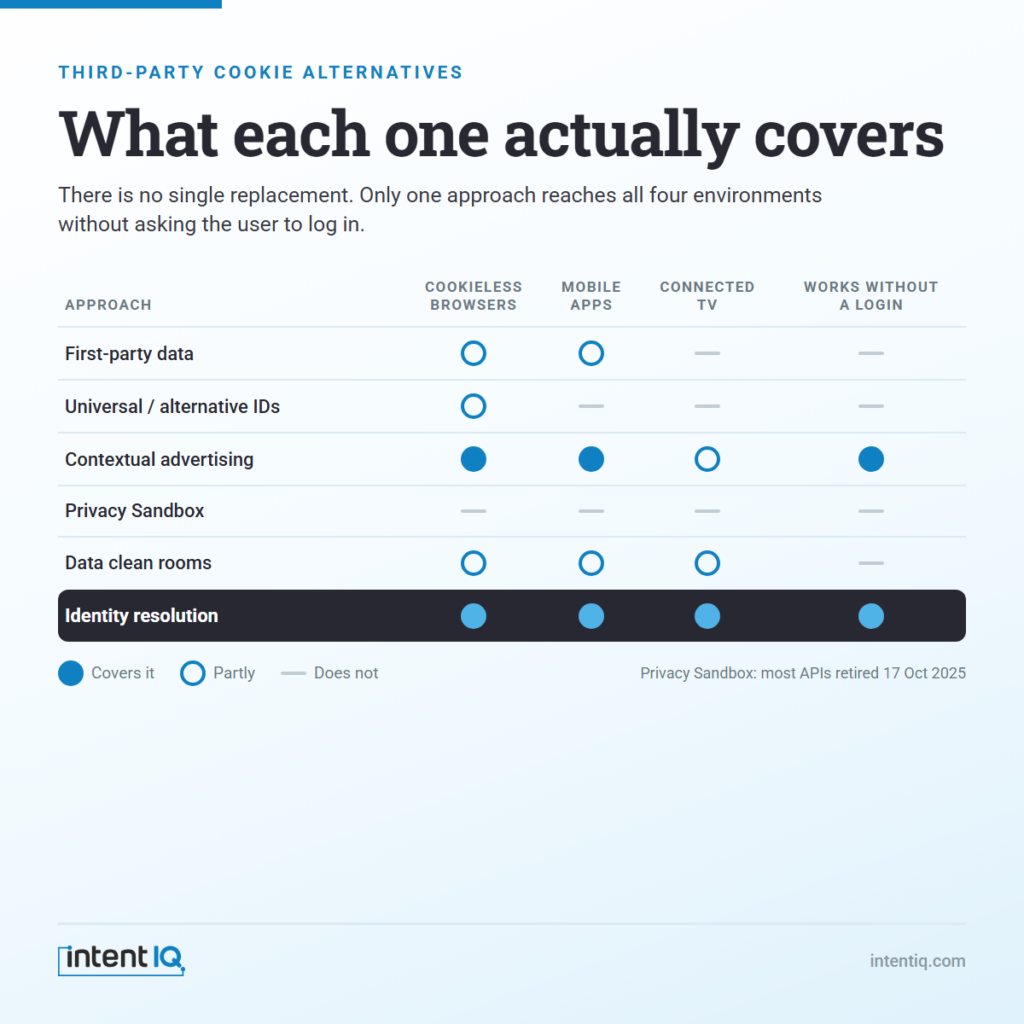
The real third-party cookie alternatives in 2026, what each one actually covers, and why Privacy Sandbox is no longer among them. For advertisers and publishers.
Read More
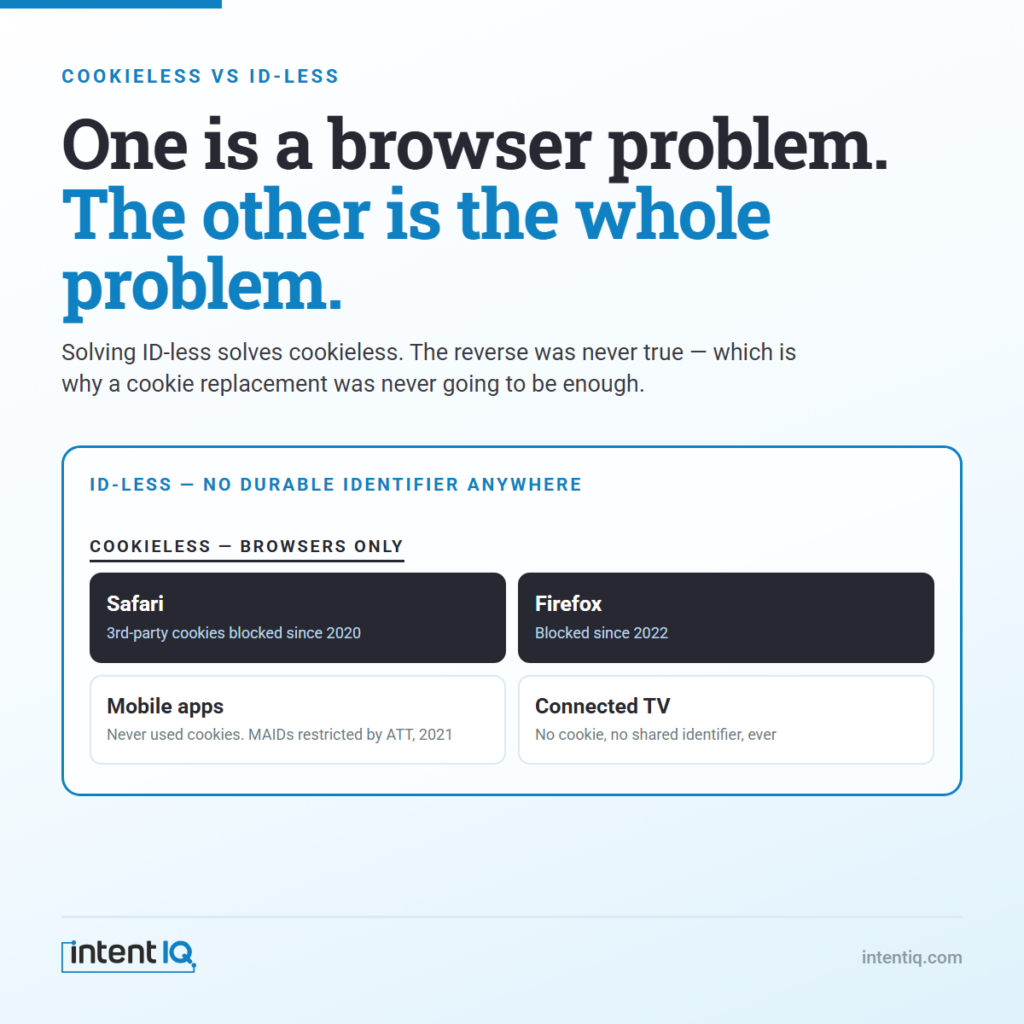
Cookieless means browsers without third-party cookies. ID-less means every environment without a durable identifier — including apps and CTV. Here is why it matters.
Read More
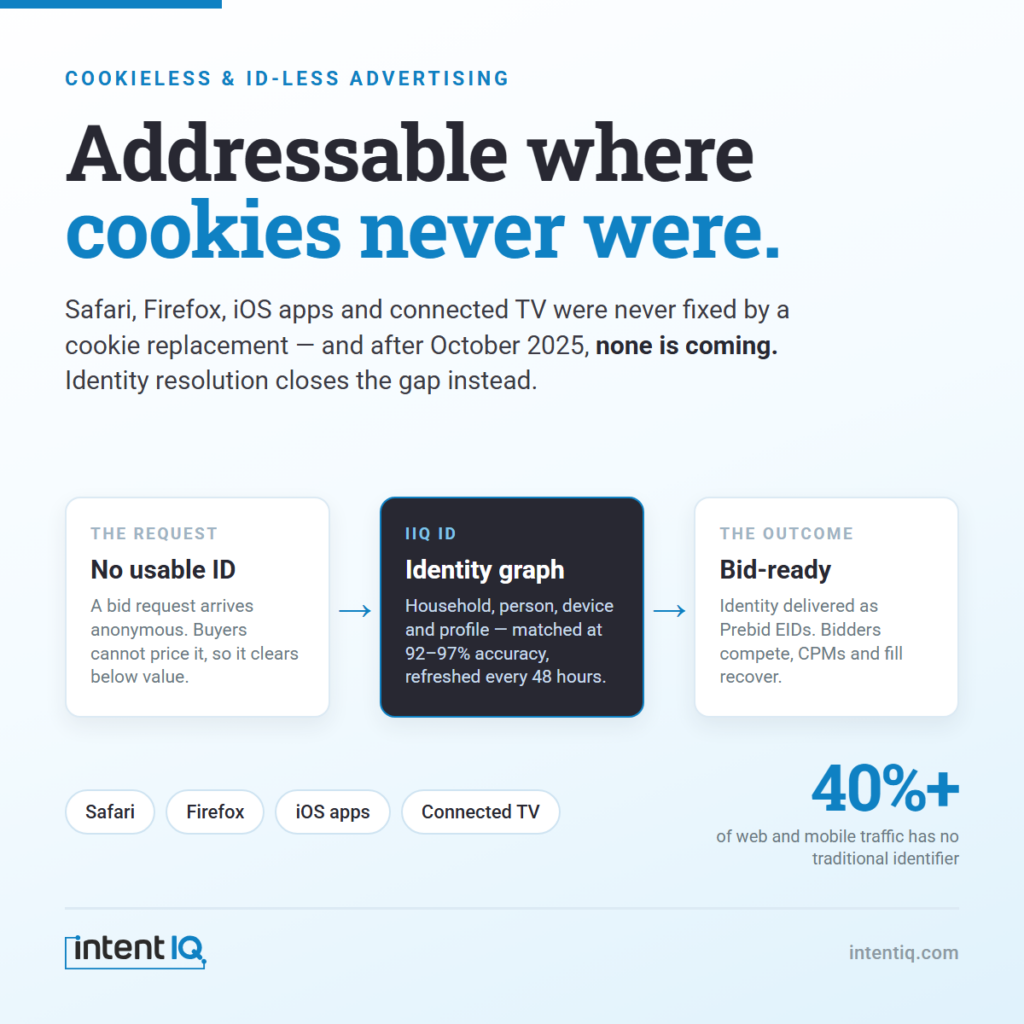
Key Takeaways Cookieless advertising means reaching and measuring audiences where third-party cookies do not exist — Safari, Firefox, iOS apps and connected TV. More than 40% of web and mobile traffic is already in those environments. Chrome kept third-party cookies, and the replacement never arrived. Google abandoned deprecation in July 2024 and retired most Privacy Sandbox APIs in October 2025.
Read More

For years, the advertising industry’s identity conversation has focused on a single challenge: maintaining addressability in the face of signal loss. As third-party identifiers declined, privacy regulations expanded, and consumer behavior became increasingly fragmented across devices and channels, the industry responded with significant innovation. New identifiers emerged. Identity graphs expanded. Deterministic and probabilistic approaches evolved. The focus was clear: preserve
Read More

As third-party cookies face complete obsolescence and Apple’s ITP continues to aggressively limit data retention across Safari and iOS, publishers and advertisers are confronting a massive addressability gap. Resolving identity across channels has transformed from a sophisticated marketing luxury into a foundational business necessity for digital monetization. However, with dozens of alternative ID vendors entering the landscape, identifying a sustainable,
Read More

Identity resolution is no longer a niche capability reserved for enterprise data teams. In 2026, it has become the operational backbone of every serious advertising strategy — the difference between reaching a real person and wasting an impression on a ghost. But despite its growing importance, the industry is still falling short. A new State of the Industry report by
Read More

In the current digital landscape, media buyers are facing a significant hurdle: the loss of granular performance data. For years, the Mobile Advertising ID (MAID) was the north star for tracking user journeys and optimizing campaigns on iOS. However, with the onset of Apple’s App Tracking Transparency (ATT) and the deprecation of IDFA, that star has faded. Today, the industry
Read More

While most of the industry is still mourning the loss of third-party cookies, top-tier marketers have already moved on to a more lucrative metric: Revenue Lift. ID Bridging isn’t just a technical workaround for Safari signal loss; it’s a strategic engine that connects fragmented identities into a cohesive, high-performance ROI machine. In the current landscape of digital advertising, “signal loss”
Read More

In the digital advertising ecosystem, the path to purchase is rarely a straight line. A user might see an ad on their Connected TV (CTV) in the morning, browse products on their mobile device during a commute, and finally convert on a desktop in the evening. Modern identity resolution has evolved beyond a static ‘link’ between devices. We are entering
Read More