
 Partners Login
 Contact Us
Identity resolution is no longer a niche capability reserved for enterprise data teams. In 2026, it has become the operational backbone of every serious advertising strategy — the difference between reaching a real person and wasting an impression on a ghost.
But despite its growing importance, the industry is still falling short. A new State of the Industry report by Digiday and Intent IQ found that only 21% of brands, agencies, publishers, and retailers feel “very confident” in their ability to accurately identify and reach their target audiences across digital channels. The identity crisis isn’t coming — it’s already here.
This guide explains exactly what identity resolution is, how it works, why traditional approaches are failing, and what it takes to get it right.
What Is Identity Resolution?
Identity resolution is the process of connecting data points from multiple devices, browsers, channels, and platforms to recognize that they all belong to the same person.
Consider a simple example: a consumer browses a retailer’s website on their laptop in the morning, sees a retargeted ad on Instagram via their iPhone at lunch, and completes a purchase through a shopping app on their tablet that evening. Without identity resolution, these appear as three separate, unrelated users. With it, you understand this is a single customer journey — and you can attribute, measure, and optimize accordingly.
At a technical level, identity resolution draws on two core types of matching:
Deterministic matching links identifiers using exact, verified data points — a logged-in email address, a phone number, a known user ID. This approach offers the highest precision because it relies on confirmed facts, not inference.
Probabilistic matching uses statistical modeling to infer connections between data points. If two devices consistently connect from the same IP address, use the same Wi-Fi network, and share similar browsing patterns, a probabilistic model infers they likely belong to the same household. It offers greater scale than deterministic data alone, at the cost of some precision.
The most effective identity resolution solutions combine both approaches, using deterministic data as the anchor and probabilistic modeling to extend reach into otherwise unaddressable environments.
Why Identity Resolution Has Become a Business Priority
The need for identity resolution is not new, but the urgency has never been greater. Several forces have converged to make accurate identity the defining challenge of the current era.
The Collapse of Traditional Identifiers
Third-party cookies have been blocked on Safari and Firefox for years. Apple’s App Tracking Transparency (ATT) framework has restricted mobile ID sharing across iOS apps. Even on Chrome — still the world’s dominant browser — Google’s much-publicized reversal on third-party cookie deprecation has not eliminated signal loss. It has simply delayed it while creating uncertainty.
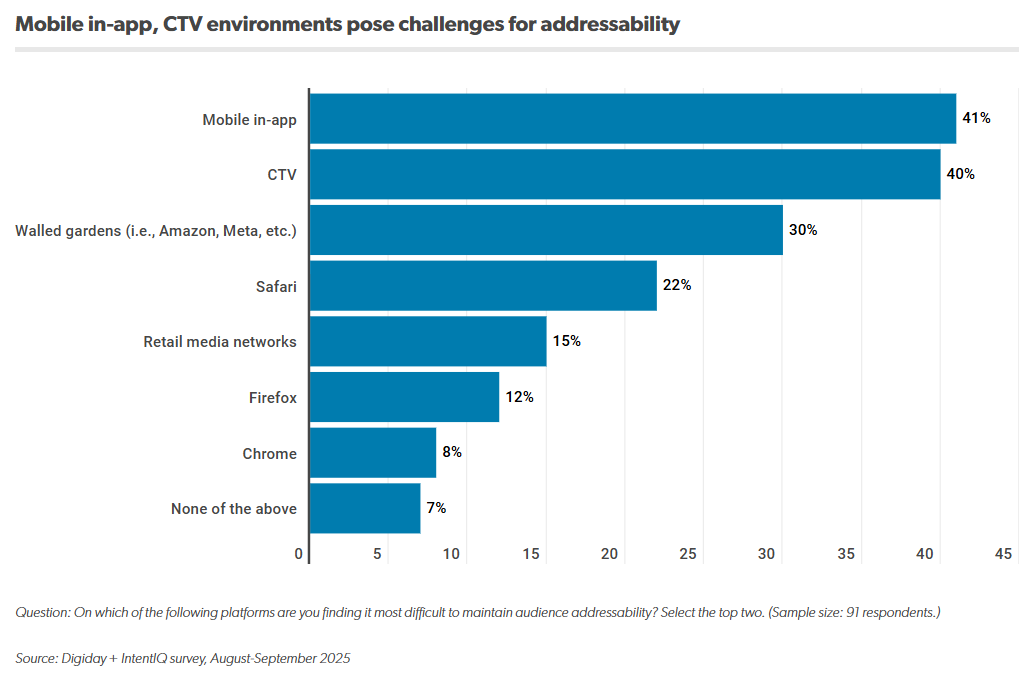
According to the Digiday/Intent IQ research, the most challenging environments for audience addressability are mobile in-app (41%), CTV (40%), and walled gardens (30%). Among browsers specifically, Safari presents the biggest challenge (22%), followed by Firefox (12%).
Fragmentation Is Getting Worse, Not Better
The modern consumer journey doesn’t follow a straight line. Consumers interact with brands across an average of 21 connected devices per household. They move between cookieless environments, walled gardens, streaming platforms, and in-store experiences — often within the same day.
Without a consistent identity layer connecting these touchpoints, marketers can’t cap frequency, measure reach, or accurately attribute conversions. They end up over-serving the same ad to the same person on some channels while completely missing them on others.
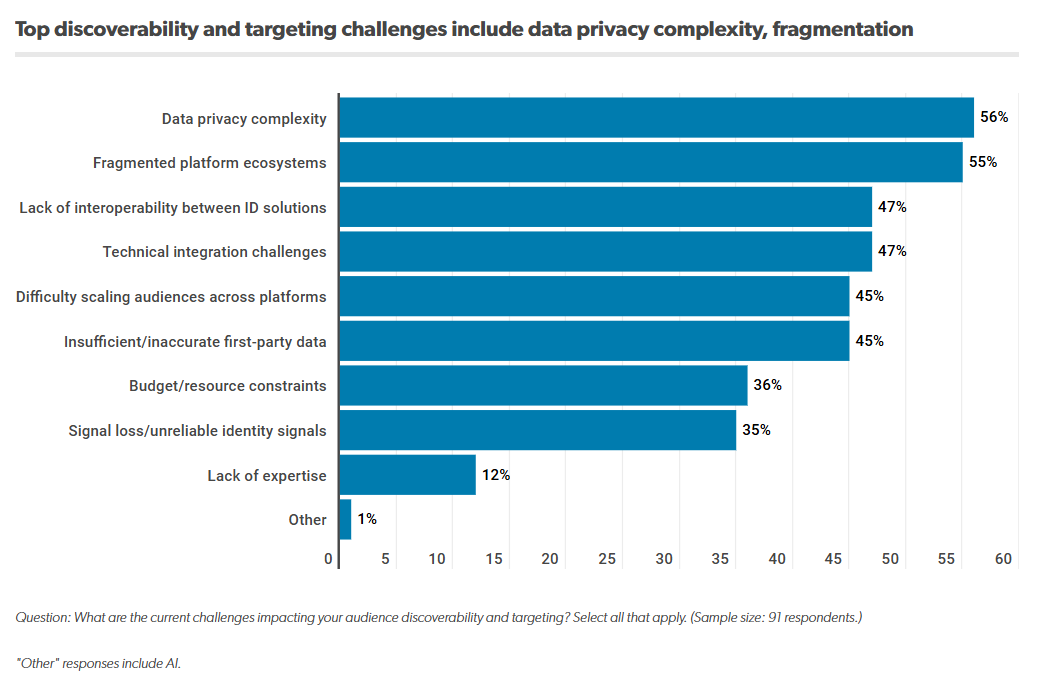
The leading challenges impacting audience targetability, according to the Digiday/Intent IQ survey, are:
Cookieless Inventory Is Revenue Left on the Table
Publishers are feeling the squeeze from the other side. According to research featured in the AdMonsters playbook Monetizing Audiences in Cookieless Environments, 55% of publishers rely on open exchanges for cookieless inventory — the lowest-value, most commoditized path to monetization — while 60% lack confidence in how they measure identity performance.
The opportunity cost is enormous: nearly half of publishers surveyed expect a 10–20% revenue lift from properly deployed identity solutions. The gap between expectations and outcomes isn’t a technology problem — it’s an implementation and strategy problem.
How Identity Resolution Actually Works: The Core Architecture
Modern identity resolution is built on an identity graph — a data structure that maps relationships between various identifiers (cookies, device IDs, email addresses, IP addresses, MAIDs, login tokens) and links them to a single individual or household profile.
Building and maintaining that graph requires three core components:
1. Tokenized Data
Tokenized identifiers — like mobile advertising IDs (MAIDs) — allow systems to understand a person’s online behavior without requiring personally identifiable information (PII). These identifiers are collected across digital touchpoints, then resolved down to an entity level.
2. Offline Reference Data
PII — names, postal addresses, email addresses, phone numbers — anchors digital behavior to known individuals. This offline reference graph is what separates deterministic resolution from guesswork. It’s the foundation on which digital signals are validated.
3. Matching and Resolution Logic
Advanced algorithms process both the tokenized and offline datasets, matching disparate signals to create consistent, persistent identities. Resolution can happen at the individual level or the household level, depending on the use case.
The key word is persistent. A well-built identity graph doesn’t just match today’s signal — it maintains the connection across sessions, devices, and time, so that the profile remains usable as individual signals appear and disappear.
The State of Identity Strategies Today
Despite the pressure from signal loss, the industry’s identity toolkit in 2025 remains heavily weighted toward legacy approaches — though that is shifting rapidly.
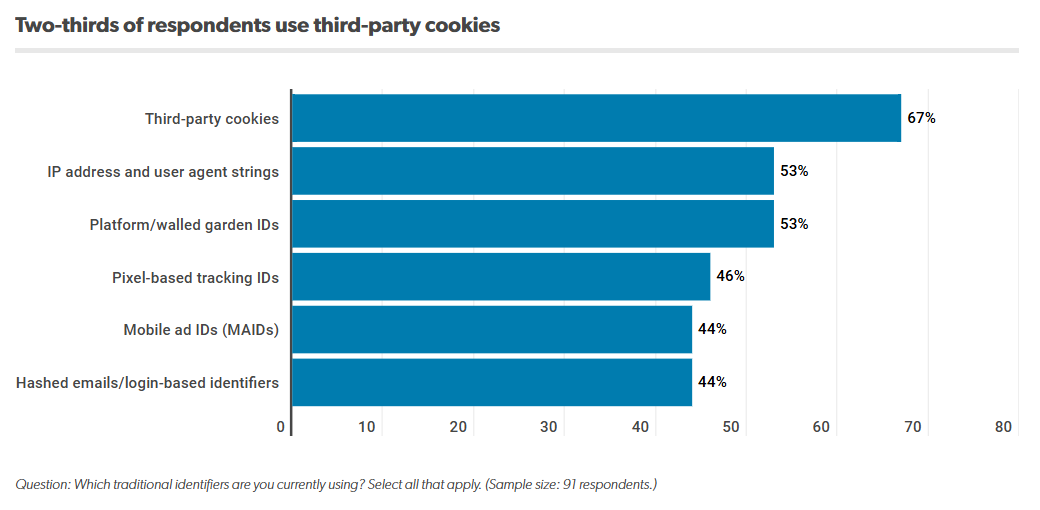
According to the Digiday/Intent IQ report, 67% of respondents still use third-party cookies, with IP/user agent strings and walled garden IDs each used by 53%. At the same time, 50% are investing in or experimenting with first-party IDs, and 58% are using alternative ID solutions including deterministic and cookieless options. Only 25% are not using any alternative IDs at all.
The primary motivations for implementing identity solutions are data enrichment (64%) and measurement and attribution (63%), followed by revenue optimization (44%) and privacy compliance (36%).
The Shift to Alternative IDs: Slow Now, Fast Soon
The adoption of alternative IDs is accelerating — but unevenly. Google’s decision to maintain third-party cookies in Chrome caused some organizations to pause their migration, with 56% reporting a limited impact on their strategy and 33% reporting no impact at all. Only 11% have fully paused their migration.
But when respondents were asked what their identity mix will look like in 2026 versus today, the picture changes dramatically:
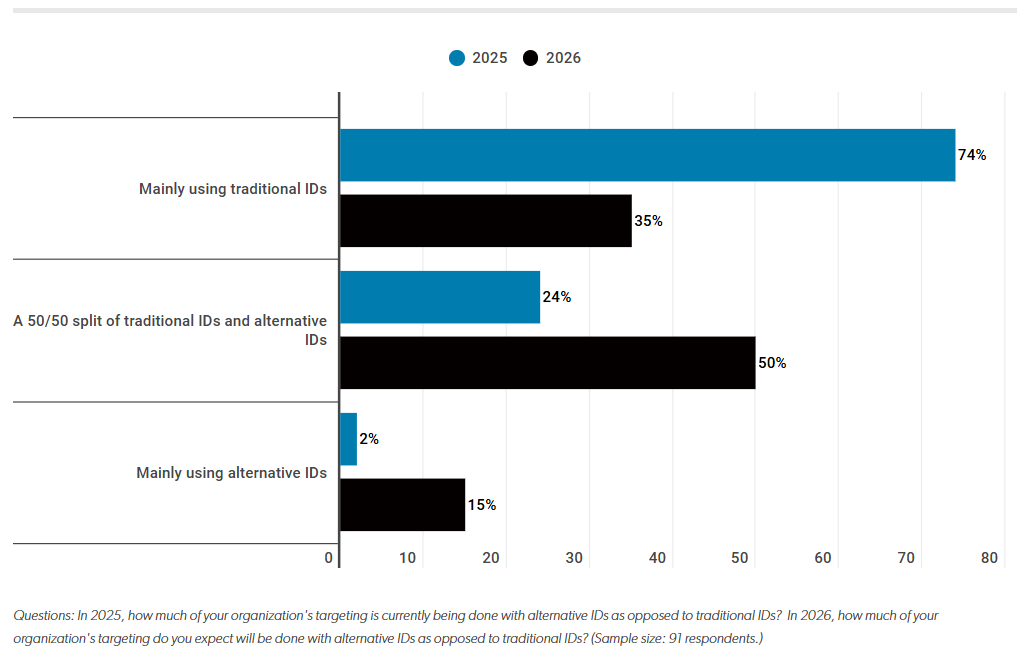
The share of respondents expecting to use mainly alternative IDs is projected to jump 650% — from 2% to 15%. The share expecting an even split of traditional and alternative IDs more than doubles, from 24% to 50%. This is not a slow evolution. It is a rapid structural shift that is already underway.
What Good Identity Resolution Delivers: Measured Outcomes
The business case for identity resolution is increasingly measurable. The Digiday/Intent IQ report found that 63% of respondents who have adopted alternative IDs report that they have improved ad performance, while only 2% report a decrease.
The most effective channel for alternative ID performance? AVOD and streaming platforms, cited by 39% of respondents — precisely the cookieless environment where traditional IDs have no foothold.
For context on what this means in practice, consider results from real deployments:
- A higher education campaign using Intent IQ’s identity graph to resolve users on Safari and iOS achieved a 41% lift in conversions, 38% more leads from previously un-targetable environments, and a 44% reduction in Cost-Per-Lead.
- Whirlpool used identity resolution to eliminate 200,000 duplicate audiences, enabling 5x greater reach to addressable audiences while directly cutting wasted media spend.
- Tailored Brands resolved all known and tokenized data to a single identifier, achieving 26% higher ROAS for Men’s Wearhouse and a 42% increase in incremental revenue for Jos. A. Bank.
The common thread: in each case, identity resolution didn’t just improve targeting — it recovered value that was previously invisible or inaccessible.
The Publisher Perspective: Unlocking Cookieless Revenue
For publishers, identity resolution is fundamentally a yield story. The AdMonsters research makes this clear: more than half of publishers are currently leaving significant revenue on the table by defaulting to open exchange monetization for their cookieless traffic — the lowest-CPM path available.
The path to higher yield lies in being able to identify users in cookieless environments and package that inventory for private marketplace deals. When publishers can resolve user identity across Safari, Firefox, and iOS — and accurately match demand platform IDs to a single user — they unlock the ability to command premium pricing from buyers who otherwise couldn’t reach those audiences.
Identity resolution allows publishers to:
- Create addressable audience segments from cookieless traffic and offer them as PMP deals
- Reduce auction pressure uncertainty by providing buyers with confidence about who they’re reaching
- Attribute performance from campaigns that touch cookieless environments, making the case for incremental spend
- Build first-party data infrastructure that compounds in value over time
The demand for this capability is real. Revenue lift measurement is the primary KPI used to evaluate identity solutions (cited by 67% of respondents), followed by A/B testing and CPM uplift tracking (each at 50%). Publishers in private marketplace programmatic direct deals with a shared identity approach are seeing 20–40% lift in CPMs relative to non-identified inventory.
What to Look for in an Identity Resolution Partner
As the market matures, choosing the right identity partner has become a more sophisticated decision. The Digiday/Intent IQ report identified the capabilities that matter most to buyers: standardized reporting and unified frameworks (64%), insight into how IDs translate to audience attributes (60%), better understanding of identity signal quality (55%), and better support for cookieless and ID-less environments (53%).
When evaluating a partner, three criteria stand out:
Deterministic grounding. How much of the graph is validated against verified, deterministic truth sets? Solutions built primarily on probabilistic inference degrade faster as signal loss intensifies. Ask how frequently the graph is tested and recalibrated against ground truth data.
Interoperability. Can the identity solution coexist with — and complement — your existing ID stack? No single universal ID will win. The best solutions are those that can work alongside other IDs, expanding scale without undermining existing frameworks. This is especially important in GDPR regions where consent-based data flows require careful design.
Proof of performance. Look for verifiable, test-based evidence of revenue lift or match rate improvement — not modeled projections. The best partners measure effectiveness through A/B testing, CPM uplift analysis, and revenue attribution on an ongoing basis.
Privacy by design. In 2026, privacy compliance is not a differentiator — it is the baseline. Look for solutions that operate without fingerprinting, without exposing PII, and with explicit support for GDPR, CCPA, and evolving regional frameworks.
The Road Ahead: Identity as Infrastructure
The consensus from practitioners is that identity resolution is moving from a discrete tool to an embedded utility. By 2026, identity will be fully embedded into the fabric of activation and measurement. The distinction between ID solutions and media platforms will blur — identity resolution will become a core utility powering attribution, frequency management, and optimization across every channel.
This convergence will be shaped by AI. Machine learning models that can learn from verified identity graphs — inferring connections probabilistically while remaining grounded in deterministic truth — will extend the reach and accuracy of identity solutions into environments where traditional matching fails entirely. Contextual signals will become more AI-driven and automated, replacing the manual segment-building workflows that dominated the previous era.
The implication for publishers, brands, and agencies is clear: identity resolution is no longer a project to deprioritize until cookies finally disappear. It is the infrastructure investment that determines whether your organization can function in a fragmented, privacy-first ecosystem — or whether you’re left operating on incomplete maps while competitors navigate with confidence.
Key Takeaways
The data tells a consistent story across both the Digiday/Intent IQ State of Identity research and the AdMonsters publisher survey: the industry knows identity resolution is critical, but most organizations are not yet executing it effectively.
The gap between “somewhat confident” and “very confident” — between using open exchanges for cookieless inventory and unlocking PMP revenue — is an identity gap. And closing it is one of the highest-leverage investments available to publishers and marketers right now.
The organizations that will lead in 2026 and beyond are those that treat identity not as a cookie replacement, but as the foundational layer on which all addressability, measurement, and personalization is built.